U.S. companies end Pride sponsorships as anti-DEI pressure mounts

Add Axios as your preferred source to
see more of our stories on Google.
/2025/05/06/1746565921379.gif?w=3840)
Illustration: Brendan Lynch/Axios
As part of diversity, equity, and inclusion walk-backs, many companies said they would no longer participate in "external events" or pledges, namely Pride parades that will take place across the country next month.
Why it matters: This is a major pivot for the once proud corporate America.
State of play: Mastercard, Citi, Pepsi, Nissan and PwC pulled sponsorship of NYC Pride. Booz Allen Hamilton and Deloitte pulled out of WorldPride Washington, D.C., and Anheuser-Busch, Comcast and Diageo stopped sponsoring San Francisco Pride.
- Meanwhile, Minneapolis' Twin Cities Pride rejected Target's sponsorship dollars citing wishy-washy support of the LGBTQ+ community and its DEI rollbacks.
What they're saying: Consumers and employees want to understand what a company's values are and what its brand presence is, says Ben Finzel, president of RENEWPR.
- "It's about consistency in message and action," he said. "This is not about being popular or being performative, it's about being focused on what is core to the business and its key stakeholders."
By the numbers: 39% of corporations are scaling back external Pride Month engagements this year, according to Gravity Research data.
- This is a sharp increase from last year, when only 9% said they were changing their external Pride engagement.
- 57% of companies that are federal contractors plan to reduce external engagement, highlighting the risk of federal investigations.
- Only 14% report decreasing internal engagement, although some groups — including health care companies and federal contractors — are more likely to scale back internal engagement as well.
Of note: 89% of Democrats, 62% of Republicans and 78% of independents support protections for LGBTQ+ people, according to a recent Public Religion Research Institute survey.
Zoom in: The risk for engaging around LGBTQ+ issues has increased 42% since this time last year, according to GravityResearch insights shared with Axios.
- The most scrutinized corporate actions internally include insurance coverage for gender-affirming care, bathroom access policies, preferred pronoun usage and LGBTQ+ employee resource groups.
- Meanwhile, the external engagements that are most scrutinized are Pride festivals or related event sponsorships, third-party surveys or corporate rankings, and donations or support for LGBTQ+-focused nonprofit organizations.
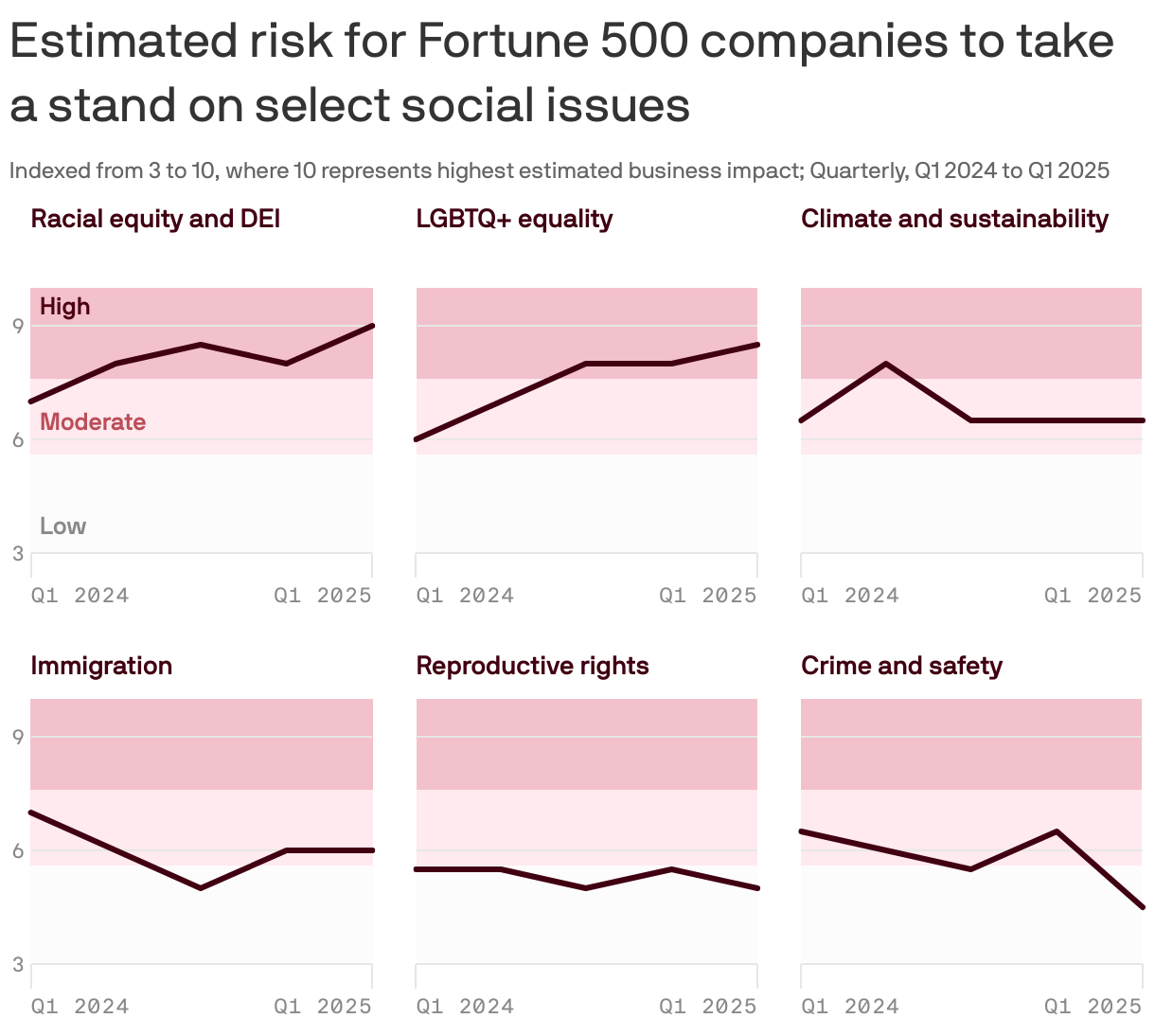
Roughly 6 in 10 companies cite the Trump administration as the top reason for this change, while conservative activists and conservative policymakers come in second and third, per Gravity Research.
- Because of this, companies with government contracts are more likely to retreat, says Fabrice Houdart, founder and executive director of the Association of LGBTQ+ Corporate Directors.
- This includes "companies in the financial industry, the consulting industry, manufacturing, or heavy industries that don't really have that pressure to talk to the LGBTQ+ consumer," Houdart said. "You see it with companies like Deloitte, or companies like Goldman Sachs, which are kind of leaving the LGBTQ+ agenda behind."
- Meanwhile, companies that are in the business of culture — like those in fashion, beauty and tech — are more likely to continue to support LGBTQ+ issues due to the communities they serve, Houdart added.
Zoom out: This retreat from Pride isn't happening across the globe.
- Next week, more than a dozen stock exchanges will participate in the first-ever global "bell ringing" for LGBTQ+ equality.
- "I don't think that the anti-DEI message is resonating in Europe," says Houdart. "It has become so caricatural that I think it's probably going to have the inverse reaction, which is that European companies are going to double down on their commitment to corporate social responsibility."
Between the lines: Communicating in this climate remains tricky, says Finzel, and getting it wrong could do major damage to reputations.
- Companies should avoid pandering, recognize that principles matter and should play to their strengths. "What have you always done? Keep doing that," he adds.
More on Axios:
